Wednesday, July 25, 2012

CDW Part 4: Tarayana Foundation

Karma Wangchuk, a programme officer at the Tarayana Foundation, attended the Curriculum Design Workshop as the lone representative of his organization. Since much of the workshop was based on group activities, he had his work cut out for him. But Karma showed dedication and enthusiasm for the work and carried on to present a very convincing final presentation that illustrated his grasp of the material. 

When we met up a week later to discuss the next steps that Tarayana could take, Karma was still very enthusiastic about the experience and said one of the most lasting impressions was Dr. Tho Havinh's use of the Four Noble Truths as a lesson planning tool. Dr. Tho is setting up a new GNH Center in Bumthang, by the way, a project to be watched!

It was a pleasure to have Karma at the workshop, he was an active participant, fully engaged, insightful and willing to go the extra mile. He developed an entire KUD on his own. Below is how he used the Four Noble Truths to address the issue of rural to urban migration. I think he raised some excellent Essential Questions, particularly the last one. We mustn't underestimate the capability of rural villages to understand the concept of systems that control them, and by understanding those systems they will be better equipped to find their own strength and resiliency. 


SUFFERING: Rural to Urban Migration

CAUSES OF SUFFERING: Often rural villages are not aware of their role and worth, there is growing lack of respect for the traditional way of living, mis-representation of town and city life in media, they don’t know the difference between need and want, lack of proper facilities (market, cooperatives, banks, hospitals, schools), new roads, media/television.

CESSATION OF SUFFERING/GOALS/OBJECTIVE: To support villages and rural communities in such a way that the youth don’t feel the need to migrate. Drawing attention to the fact that village life can be fulfilling and interesting.  Provision of facilities.

PATH: Providing relevant education and facilities not simply transplanting urban education and facilities, instead creating unique models of education, cooperatives, self help groups and promoting ecotourism.

ESSENTIAL QUESTIONS:
Why money is not equal to wealth?
What will happen if all the rural communities migrate to urban areas?
What will happen if all farmers give up farming?
How will electricity change our lives?
How do roads change the community?
Does sending your children to government school affect the family and community? Is it always a positive?
What systems control our lives (environmental, family, government, corporate)?

Good Job Karma!


Monday, July 16, 2012

CDW Part 3: Royal Education Council

Thimphu group's final presentation.
The Royal Education Council sent the largest group of all the partner organizations: 12 teachers from its seed schools in Thimphu and Paro for the entire workshop, plus four Master Teachers for the first week.

This was a challenging group because 1) they are the most bound by existing structures imposed by the ministry of labor and therefore the least flexible when it comes to making institutional wide changes and 2) they are the most "workshopped" bunch of them all. After working long hours for long weeks for long months, their only vacation time is spent...at workshops. At these workshops they are given mountains of good ideas but then they must move those mountains into their little classrooms. So they had our sympathies.

Thimphu group hard at work.
All that said, they also worked very hard on imagining a different way of teaching. Pawan Gupta explained to them that textbooks are a means not an end and encouraged them to extract only what is relevant and meaningful from textbooks but then to use the local and natural environment as the text. "Be Brave!" was our motto throughout the workshop and of all the groups, the REC gents and madams had to be the most brave.

The Thimphu group did a great job presenting their "take aways" including many of the active learning strategies we had modeled and some of the methods we illustrated including: Multiple Intelligence, Brain Based Learning, Listening Skills, Theater in the Classroom, Subject Integration, Project Based Learning, The Four Noble Truths for Lesson Planning, and, importantly, the KUD (Know Understand Do) method of unit planning, or block planning as they call it. They said that they were committed to using these in their classrooms as well as continuing with their meditation instruction with their new deeper understanding after Nima, Jackie, and Lama Shenphen's meditation sessions.

Madam Kuenzang and
Madam Tshewang
helping out on day one. 
Specifically they want to incorporate Community Based Culture into their existing curriculum and they developed a set of essential questions around that theme with an outline of a field trip that could help answer those questions. They ended their presentation with a song that they wrote...it was lovely!

The Paro Group created a special unit based on vegetables so students can make informed decisions about what to buy and what not to buy or what is best for an individual or community. They created two lesson plans around their KUDs and essential questions.


The group of master teachers lead by Madam Tshewang and Am Dechen Tshomo, Gep Tshering and Kuenzang Dema were super fantastic, sharing all kinds of brain boosters, active learning strategies, and class building activities that kept the workshop feeling very alive. Our favorite was Madam Tshewang's Charo Charo brain booster, lifted from Mrs. Das's workshop but "Bhutanized". In the original game, we would sing My Bonny Lies Over the Ocean and every time there was a B word we had to stand if we were sitting or sit if we were standing. In this version we sang Charo Charo (Friend Friend) and used the C words to sit or stand. Here's a rough clip:


One great outcome, and something several REC teachers mentioned in their assessments was that they got to interact with teachers and instructors from many different kinds of institutions and they seemed to really appreciate sharing experiences. Here's a picture of Phuntsho Rabgay horsing around with Dawa and a few of the NFE instructors.


Thanks to all the REC teachers for spending their break with us and to Mr. Lhundup Dukpa from REC for arranging everything. It was a real pleasure working with all of you!

Still to come: Bhutan Nuns Foundation, and Tarayana Foundation.

Sunday, July 15, 2012

CDW Part 2: Ministry of Labor

We did our very best to give each of our participating organizations individual and personal attention. Whenever we broke into Lesson Planning Sessions, one of our resource people would be assigned to a group, sit with them, observe them, and really listen to the issues they face so that we could provide the most relevant assistance. The original plan was to have them rotate every so often but the NFE group quickly bonded with Jackie Mitchell of the Shambhala School and she ended up spending the whole workshop with them. We found that combination of Pawan-ji with the teachers from the Royal Education Council government seed schools created a healthy challenge. Randi Dickson worked closely with the Bhutan Nuns Foundation and REC, though she brought her patience and expertise to the tables of nearly every group. Evan Moss also pitched in with her thoughtful and optimistic support, always there when she was needed. Meanwhile, the crack team from the Ministry of Labor and Human Resources Vocational Training was extremely adept at synthesizing the content sessions into their group work and often didn't need our help at all! We would observe them in awe as they swiftly came up with a most impressive plan. It also soon became apparent that the Bhutan International School of Hospitality and Tourism could easily fold into the vocational training group and a good partnership between the two was struck. 


Ministry of Labor and Human Resources, Vocational Training 

Mission: A nation where all its citizen have the opportunity for a gainful and quality employment characterized by harmonious and productive relationship in the workplace and the broader community.


Kinley, Norbu, and Karma from MoLHR,
Chencho from BISHT
with Evan Moss in the middle.
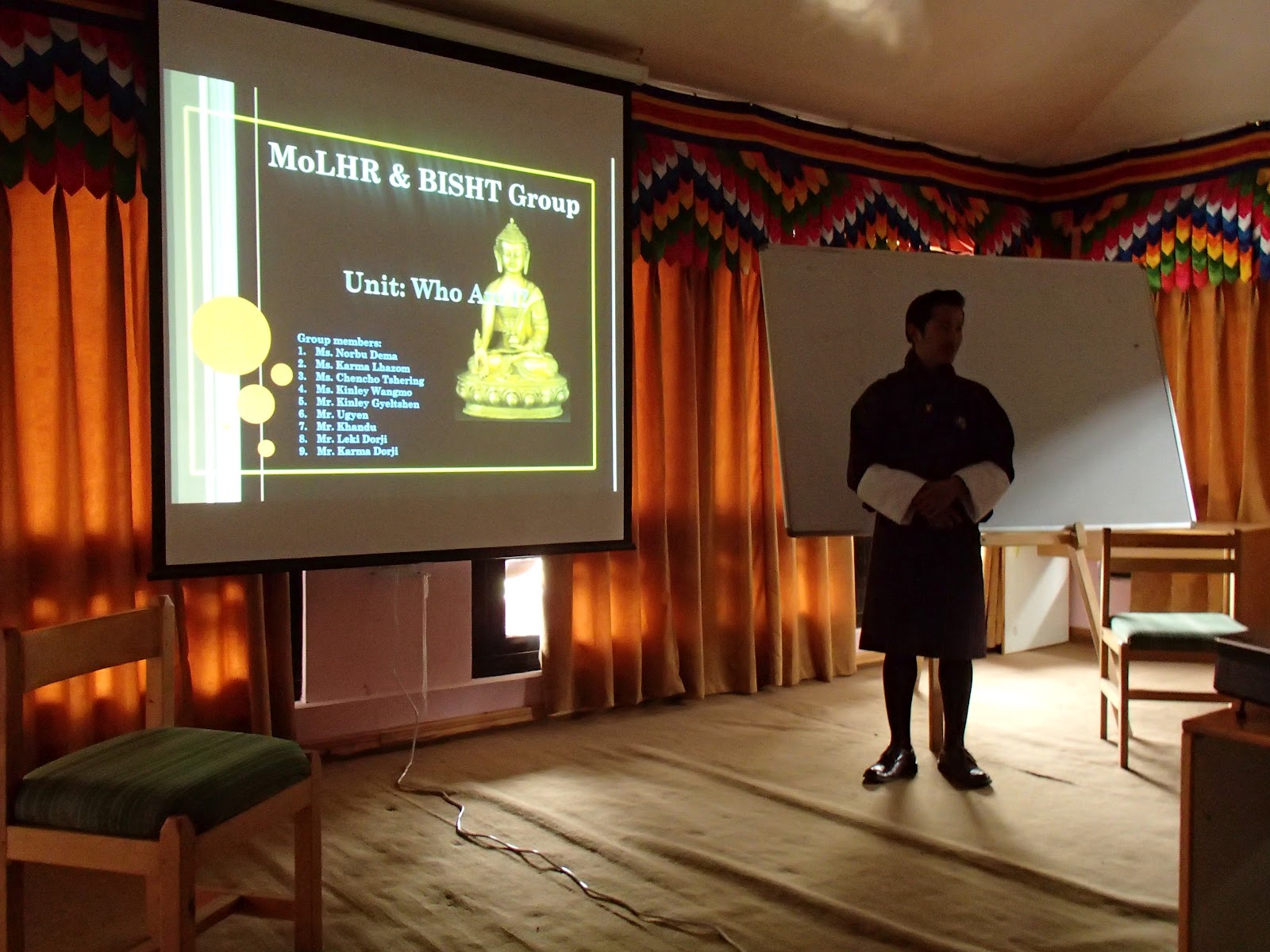
The Ministry of Labor and Human Resources sent an excellent team of four Program Officers and three instructors from its Technical Training department to address issues they face in educating the labor sector. They joined forces with Chencho Tshering from the Bhutan International School of Hospitality and Tourism (BISHT) to create a concrete plan that will change the way vocational trainees begin their education at MoLHR institutions.
Presentation on the final day.

They identified their main issue as dignity of labor. A unit that helps students understand themselves, recognize their strengths and weaknesses and set clear goals for their futures might help them navigate the rest of their training with more dignity.

They developed one sample lesson plan that asks students to identify one of their heros, whether they be in the family, local heroes, mythical heroes or someone from the media. They will be asked to reflect what types of characteristics those heroes have through a number of activities that are designed to bring out their various skills and strengths based on Dr. Tho's multiple intelligence model. Mindfulness practice will also be introduced. The team, saying late almost every night, actually developed about ten lesson plans but only shared the one with the group because of time contraints. We are very much looking forward to seeing more from this dedicated group.

Karma giving a presentation of the issues
MoLHR faces early in the week.
The team is going to propose that MoLHR introduce a new 1 week intensive for new students at the beginning of each year, with follow up 2-3 hours per week thereafter. The pilot project will begin at 3 vocational training centres, or what they now are calling Technical Training Institutions, beginning in August 2013, which will give them enough time to fully develop the unit and train instructors. Meanwhile, BISHT will begin implementation on a small scale immediately.

Again, many thanks to Kinley Wangmo, Ugyen, Norbu Dema, Karma Lhazom, Leky Dorji, Khandu, Kinley Gyeltsen and also to Mr. Karma and their Director for their unwavering dedication and hard work.


Download the MoLHR unit here:  http://www.lhomon.bt/education/cdw/workshop-outcome/

Next up...The Royal Education Council Thimphu and Paro, Bhutan Nuns Foundation, and Tarayana Foundation.

2012 LME Curriculum Development Workshop Part 1: CGI and NFE

Lhomon Education's 2012 Curriculum Design Workshop at Paro College of Education came to a close on Thursday, July 12th, with an afternoon of presentations at Hotel Holiday Home by our participants. We had a total of 45 participants from six organizations, 5 full time resource people and a number of special guests attend the workshop. It was a rich experience, generating important conversations and leading to some key new connections. Dasho Pema Thinley, Vice Chancellor of the Royal University of Bhutan officiated the opening lighting of the butter lamp, and also came to our closing ceremony. He said he was most impressed by our ability to bring together such an amazing group of people with a joint vision of bettering Bhutanese education.

At the closing ceremony, each group had 20 minutes to demonstrate what they had learned and detail their implementation plans. Even though we had provided ten days packed with sessions on a variety of relevant subjects—the importance of project based learning, methods of integration, mindfulness in the classroom, using theater/improv in the classroom, the four levels of listening, the Four Nobel Truths as a lesson planning tool, infusing values, using the local environment, distinctions between need and wants, combining art and math, active learning strategies, identity and storytelling, multiple intelligence—and even though they had spent ten days of hard work with intensive guidance by our facilitators, we didn't know what to expect.

In short, the presentations exceeded our wildest dreams. It was a most inspiring afternoon. Over the course of the workshop, each group had narrowed down their objectives, honed in on what was needed most, adjusted the assignments to suit their needs, ultimately coming up with strategic plans for how to change the way they are educating, some in small important ways, and others with a major overhaul.

Dawa and Lopon Dechen

Chokyi Gyatsho Institute 

The two monks from CGI, Tshering Darje and Lopon Dechen, were a wonderful complement to our eclectic group. They worked with the voluntary assistance of a senior education student at Paro College named Dawa who was a last minute addition to our roster but who turned out to be a major contributor to the workshop with his enthusiasm and active participation.

The CGI plan is to start implementation of a new curriculum in February 2012. There will be 6 units taught per year, each taking about 5 weeks, 3 hours a day, 6 days per week.

Tshering Darje
Dawa helped the monks develop a lesson plan based around water and demonstrated several active learning strategies he'd picked up during the workshop: Using a line up (shortest to tallest) to divide the group then counting us off into groups of six where we were asked to address water issues as they pertained to six different areas of study (water and health, water and government, uses of water, etc.) then come up with 3 questions on that subject. He explained that if he were to teach this unit at the monastery, he would then take the monks on a nature walk with an expert who would answer the questions as they walked.

It was a multi-faceted presentation and the whole group was actively engaged in Dawa's instruction. He will make a fine teacher and we hope to continue our work with him. The monks are heading back to eastern Bhutan to share what they learned with the others. In November I will be heading there myself to oversee the implementation of the curriculum alongside the teacher we hire (details to come!)


Nonformal Education Programme

Yeshi, Rinzin, Norbu and Dorji Wangchuk
working on their presentation.
We invited five Paro-area Nonformal Education Programme instructors to attend the workshop and were delighted by the talent and enthusiasm they poured into the work. They were a little reticent at first, there was a language barrier and they were not immediately understanding what we were trying to accomplish. But Jackie Mitchell worked closely with them from day one and they soon became one of the most active and vocal groups attending the workshop.

There was no one from an administrative level with them to help devise a long term plan but they went ahead and created lesson plans that could be used within their existing syllabus. Their focus was on linking language instruction with life skills and health awareness. They took the lead from Pawan Gupta and focused on project based learning that gives value to local wisdom and culture by using the local environment. Also drawing from Dr. Havinh Tho's presentation on multiple intelligence, they chose a project that would let people with various skills participate.

Their final lesson plan was to create a local dictionary of traditional health remedies and bioindicators (i.e. when a certain bird begins roosting, it's time to plant potatoes). Those with visual intelligence can help design and illustrate the dictionary, those with strong verbal intelligence can help translate it into Dzonghka and English, and those with strong logic skills can help figure out what it would cost to print and sell the dictionary, thus developing their basic math skills.

To top off their wonderful presentation, they did a role play, acting out some of the new classroom strategies they learned. They performed a scene where a teacher (Dorji Wangchuk) used Jackie's kinesthetic body movement for language instruction, tracing the letters with arms and adding sound and song to help memorization. All the instructors said they had learned many new techniques to use in their classes and felt energized and ready to try them out. Many thanks to Kelsang, Yeshi Jyamtsho, Norbu Wangdi, Dorji Wangchuk, and the ever entertaining Rinzin for their hard work and dedication. Bhutan is lucky to have you as teachers!


Download the Powerpoint Presentations Here.

Next...Ministry of Labor and Human Resources Vocational Training, Bhutan International School of Hospitality and Tourism, The Royal Education Council Thimphu and Paro, Bhutan Nuns Foundation, and Tarayana Foundation.


Sunday, April 15, 2012

Multiworld India

The Multiworld Network is an association of people from Asia, Africa and South America, who share a common objective to "restore the diversity of learning that existed from times immemorial." The Multiworld web site is very nice to look at and contains some excellent resources, especially for rural education.


In particular, the site hosts The Natural Farming Institute, a virtual center for the promotion of farming, based on natural principles in Asia and Africa.

They have uploaded a full curriculum that uses farming as a basis for education. When we started Lhomon Education, Rinpoche's very first request was that each school cultivate a vegetable garden, for their health and for their education. So I am very interested in what NFI is proposing, which is "to look closely into every aspect of natural farming, particularly knowledge of the soils and plants," as a means to education. They will maintain an on-line library of materials for organic farmers, directories of websites, and training courses for farmers presently using chemicals who wish to convert to organic methods.

Here is an excerpt explaining the curriculum available for download on their site:
An educational programme for the children of farming communities in India-FEB 2012:
A major focus of the Institute is the children of organic farmers whose future on the land is generally sabotaged by the existing educational system which has been designed exclusively for persons from non-rural, non-agricultural backgrounds.
"Our Land our Life" is the curriculum framework for an educational programme for children with specific emphasis on farming and farm related activities. It’s design provides a hands on approach to learning both academic and farm related topics.
The document was prepared by the Organic Farming Association of India, Taleemnet and the Natural Farming Institute with other collaborators to serve the needs of the rural and the farming communities of India. Although the emphasis is on the above, others too, specially home schooling children and alternative schools will find the document useful. 
The programme is the outcome of a yearlong research based on inputs from pioneer educators, organic farmers and academicians from across the country.
With so many wonderful initiatives and resources available, we must think creatively about ways to link and share information. We are planning to use the new Lhomon Education Web site as a resource hub, and to that end we are imagining tools and design strategies for making information easy to access and easy to share. Ideas are welcome!

A Bounty


Another magical tale from Bhutan.

One day I thought, wouldn't it be great to have a library of literature for teachers to learn about sustainable development and mindfulness? I went online and made a wish list of books. Within about one week, sponsors from around the world had donated all the books on my list. The mailing address we used was my very kind Bhutanese friend's apartment in Queens, New York. But it all happened so fast, I didn't really have a plan how to get them to Paro.

Another week passed and I was at the Dzong in Thimphu, meeting the Secretary General of the GNH Commission, Dasho Karma Tshiteem, who had just returned from the big UN Conference on GNH in New York. I shared information about the Lhomon Education Curriculum Development Workshop, and he discussed poverty alleviation. It was thrilling to be in the Dzong, by the way. There's nothing trashy about Trashichodzong, with its men marching and the gloved soldiers in glass boxes. I was in my best suit but was told to take off my scarf before entering the hallowed fortress. 

Just as I was leaving, Dasho remarked, "I think we have your books." He made a quick call and then told me that I would find the box at Am Yangchen's house, of all places. Am Yangchen! She's an old friend who I met when she played a small part in Travellers and Magicians (the village woman who detains Tshewang Dendup, forcing him to have tea with her as he tries in vain to catch the bus). I owed her a visit anyway so I walked to her house and we had a lovely catch up.

And there they were, my books. Almost 30 of them, neatly packed in a box and delivered, just 2 weeks after they entered my consciousness as a possibility.

Bhutanese resourcefulness at its best!

Many thanks to all who made this bounty possible, all the book donors, and all the couriers - I cannot imagine how they got from my friend's place Queens to JFK, through customs, off the plane, from Paro to Thimphu, then into my friend's house. And also thanks to all the writers. We are still interested in building our library so if you have any suggestions, please let me know. Our library now includes these books and more:

Affluenza – De Graaf
Big Ideas – The Center for Ecoliteracy
The Botany Of Desire – Michael Pollan
Buddhism Textbook by Dominique Side
Building Emotional Intelligence in Children - Linda Lantieri
Charlotte's Web – E.B. White
Collapse: How Societies Choose to Fail or Succeed – Jared Diamond
Cooking For Geeks - Potter
Ecological Literacy – Stone and Barlow
Educating for Wisdom and Compassion - John P Miller
Education and The Significance of Life - Krishnamurti
Food Inc - 2 Copies
Food Rules - Michael Pollan
The Great Disruption – Paul Gilding
A Guide To Green Housekeeping - Strutt
Hungry Planet - What The World Eats - Menzel
The Holistic Curriculum - John P. Miller
Kalakshetra Reflections
Literature Based Maths Grades 4-5
Look to the Mountain – Gregory Cauete
Mind Up Curriculum - Pre K-2, Grade 3-5, Grade 6-8 - The Hawn Foundation
Mindful Movements – Thich Nhat Hanh
Mindful Teaching and Teaching Mindfulness: A guide - Shoeberlein
Mindsight: The New Science of Personal Transformation by Daniel Siegel
No Impact Man – DVD
Omnivore's Dilemma – Young Adult Edition – Michael Pollon
A Pebble in your Pocket – Thich Nhat Hanh
Present Moment Wonderful Moment – Thich Nhat Hanh
A Proposal for GNH Value Education in Schools – Karma Ura
Quality Education in Bhutan – Jagar Dorji
Seeds Of Deception
Seeds Of Deception - 3 DVD set
Teaching English as a Foreign Language For Dummies
Think on These Things – Krishnamurti
What Einstein Told His Cook - Wolke
What's The Economy For Anyway? – De Graaf
Where There Is No Doctor - 3 Copies
The Whole-Brain Child: 12 Revolutionary Strategies - Daniel Siegel
Wide Awake: A Buddhist Guide for Teens - Diana Winston

Saturday, April 14, 2012

How to Get an Intern in Bhutan


Anwen at the market with her big lemon

It is possible to impose a western way of doing things in Bhutan, making people stick to schedules, getting "straight" answers, doing things "logically". But I find when I relax a bit and let the Bhutanese way take over, sometimes a little magic happens. There is an undercurrent of unspoken, indefinable activity that flows through the culture. Sometimes I worry it might dry up if too much external influence is exerted.

Two Sundays ago, I went to the Sunday vegetable market in Paro to stock up on the basics (mostly inorganic produce imported from India, sadly) and meet up with my good friends Yann and Sally. We've made a little habit of meeting at the market then fixing lunch at my house and hanging out on the verandah every Sunday afternoon. This fulfills a major aspect of GNH – being social with friends, enjoying the outdoors, taking time to cook healthy meals.

I promise this story is getting somewhere...

Yann and Sally have a bright eyed daughter named Anwen who, being closer to the ground and also more attentive than us adults, found a pen drive amongst the chilies at the market. She showed it to Yann who showed it to me and back at my place we plugged it in to see if we could track down the owner. Judging from the files, I quickly knew that it had to be someone involved in integrated curriculum development and soon found a name: Mr. Karchung. So I called my friend who is a lecturer at Paro College of Education and asked him if he knows someone named Mr. Karchung. Of course he did. This is a small country. Mr. Karchung called me and I invited him over for tea. Turns out he lives just down the road.

Also turns out he is developing curricula for remote schools who require alternatives because of their highly differentiated needs. It's common for small remote schools to have only one teacher for a school of 40 students at all different levels. So we talked about Mrs. Das's active learning strategies and differentiated instruction and after handing over his pen drive, I invited him to the July workshop. I think he'll be a perfect addition to our group.

So because of the memory chip lying in the chilis and the sharp eyes of Anwen and all the little causes and conditions, we had this fortunate meeting.

But it gets better. The next day Mr. Karchung called again. He said that his daughter Sherub Chokyi, who just graduated from Samtse College, would like to meet with me. I'd mentioned that I'd been seeking a Bhutanese counterpart and Mr. Karchung said she was interested in possibly helping us out. So today they both came back over and we had a good meeting. I found Sherub Chokyi to be smart and eager and genuinely interested in the subject at hand. So I loaded her up with movies (Schooling the World and Dhamma Brothers), books (the MindUP manual) and some sticky notes and asked her to start familiarizing herself. She'll start on April 20. I finally have my intern! I hope to learn much from her. Thanks Anwen!

Tuesday, April 10, 2012

Introducing Sally Booth, PhD


We are very pleased to have Dr. Sally Booth joining us for the Curriculum Design Workshop in July. Sally attended the Educating for GNH conference in Thimphu in December of 2009 and we invited her to a roundtable discussion in New York at the Rubin Museum of Art's education wing last summer. It was a pivotal meeting for us and Sally was instrumental in helping us change our course to become more teacher-centric in our curriculum design. Since then she has been guiding us through important decisions and developments so it is wonderful that she is volunteering her time to come all the way to Bhutan for the two week workshop. Sally is also joining our advisory committee. 
Sally is currently working as the Director of Curriculum, Research, and Professional Development at Think Global School, a one-of-a-kind high school devoted to learning through international travel and cross-cultural perspectives.  She is working with Think Global School to create and implement a travel-based curriculum as a unique foundation for student learning and experience as preparation for the International Baccalaureate Diploma Programme.  It's a fascinating idea and we look forward to sharing concepts with our participants. For more information about Sally's history as an educator, please visit our new web site.

New Web Sites Launched

Lhomon Society and Lhomon Education finally have fully functioning web sites. The LME site will eventually become a storehouse of education materials including all the curricular units generated at the July Curriculum Development Workshop, videos, web links, articles, lesson plans, and much more. We welcome your feedback. Please visit the sites at the links below.

Lhomon Society

Lhomon Education