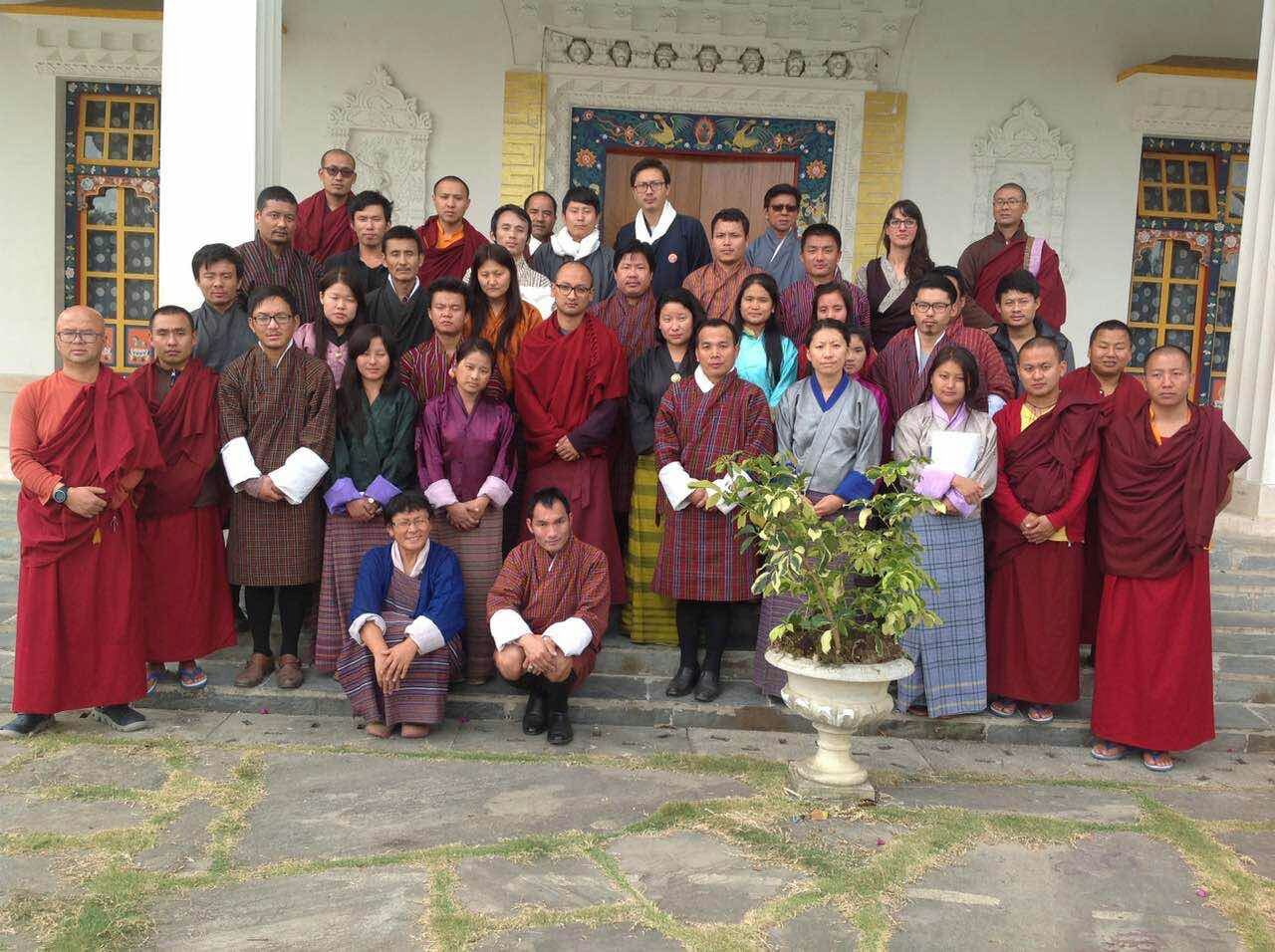
So to bring art as an important aspect of LME curriculum Dr. Yang Gyeltshen, a lead teacher has recently visited Trashiyangtse Zorig Chosum Institute to interact with Zorig Instructors and collect relevant materials for the development of LME curriculum Unit on Art and Culture.
Lhomon Education (LME) is a grassroots initiative fostering the development of innovative curricula designed specifically for Bhutanese students. The basis of the LME initiative is an alternative model of teacher training and curriculum development that integrates principles of Gross National Happiness (GNH) in the truest sense of the term.
Friday, September 8, 2017
Wednesday, July 26, 2017
Organic Gardening Class
The Organic Gardening class is part of Lhomon Education’s curriculum to provide opportunity to learn the basics of livelihood and give hands on experience.
Lhomon Education (LME) is a grassroots initiative to foster the development of innovative curricula designed specifically for Bhutanese students to integrate principles of Gross National Happiness effectively and practically.
Lhomon Education currently is a pilot program.
“Among many practical and concrete manifestations of GNH vision, the use of vegetable gardens is important to teach key dimensions of the science curriculum,” said Dawa, who is a resident teacher at the Buddhist Institute. “They learn about the elements necessary for healthy soil and ways of growing healthy food products without the use of chemical fertilizers.”
The students learn the basic aspects of organic gardening as part of their lessons, which is taught by a local farmer. The students engaged in the activity are encouraged to develop team work and cooperation rather than going for competition among their groups.
“I prefer working in the garden as compared to sitting in the class than to just listening to the organic gardening from my teachers,” said 14-year-old monk Sonam Wangchuk. “I get to work with my friends as a team. Besides, I’ve learned to make compost and garbage enzyme. I also learned to do measurements for the compost shelter. I like practical gardening work.”
The smiles and satisfactions on the students’ face during the harvest period indicate their own appreciation of the hard work and hands on learning experience that is taking place.
Lhomon Education plans to encourage and educate the community and schools around to take up organic gardening by teaching them methods of composting and other related organic practices.
By Sonam Yangdon, a journalist; TheBhutanese
Tuesday, June 6, 2017
Community Service
“We make a living by what we get, but we
make a life by what we give.” Mother
Teresa
On the
21st of May, more than 100 students from Lhomon Education, Jigme
Namgyel Engineering College and staff of Samdrup Jongkhar Initiative took part
in collecting pebbles at Rekhey community.
The volunteer
service started with the recitation of karma yoga prayer. The Karma Yoga is a
practice to apply the supreme methods for refining our intentions and
motivations to carry out any service selflessly for the greater benefit of all
sentient beings. The volunteer group was briefed to perform the task as
sincerely as possible with right mindset to accumulate merit and positive
energy. The volunteer service has been a very much part of LME students to inculcate
a sense of responsibility for the community and also to practice selflessness through
karma yoga. It is also to provide oppourtunity for students to take up leadership
role and to inspire other people that an individual can make a responsible
difference in our community.
It was
a tiring, yet satisfact ory and fulfilling day in the service of our community.
Wednesday, April 19, 2017
A poem about wind --- Written by Senior LME students
The wind that blows from the south
We can’t see it but can feel it
The wind that blows from the south
Is a gentle and calm breeze
The wind that blows from the south
Goes into our ears and noses
The wind that blows from the south
Makes happy with cool and fresh feel
The wind that blows from the south
Carries chirping of birds
The wind that blows from the south
Makes tall bamboo and tree dance
The wind that blows from the south
Helps bamboo leaves flutter and whistle
The wind that blows from the south
Makes white clouds move in the sky
The wind that blows from the south
Blows away dry and brown leaves
The wind that blows from the south
Makes dragonfly and butterfly hover on it wings
The wind that blows from the south
Makes a black eagle float on its wide wing
Tuesday, March 14, 2017
A Bow Drill
How can one possibly make a fire in a situation where there is no fire ignition tool? What if one is gone missing in a jungle where there is no settlement. Imagine how you would react to this situation where there is no matchstick or lighter? This situation is difficult for those who have not heard of ancient ways of making fire, however, it is not challenging for those who have little understanding of friction and its practical application in igniting fire during ancient time.
This art of making fire may not be completely useful in present day especially in an era of abundant light equipment, however, it connects previous generations’ cultural practices to the present generation.
Wednesday, January 11, 2017
Farm as a classroom
Here with Lhomon Education (LME), we provide
students the opportunity to learn and prepare themselves for their lives and to
fulfil their daily needs through practical hands on experience. LME endeavours
to make learning joyful to its students.
One of the activities carried out by the students is
organic garden, through which we strive to close the gap between knowledge and
practical aspect of learning. The garden becomes the classroom. Students make compost;
terrace the land and plant vegetables. It is part of their lesson and taught by
a local farmer, who does not have a teaching degree. Instead of competition, cooperation
and team work amongst students is encouraged. Harvesting vegetables from their
garden is a matter of great joy and satisfaction for the students. Learning is
taking place simultaneously.
Monday, January 2, 2017
Small steps towards building mindful schools & communities
The 7 day mindfulness camp held at Chokyi Gyatso Institute
Dewathang ended on 26th December, 2016. Its content included meditation,
mindful offering of butter lamps, selection of local agriculture produced,
waste minimization, cooking, eating & walking, karma yoga (work as
practice) & sharing of experiences. SJI as mindful choices, universal human
values as a skilful means (by Director, JNEC) & contemplative education (by
Dr. Yang Gyeltshen, LME lead teacher) as being integral to mindful
teaching-learning were also presented at the camp. Post camp school activities
& experiences were shared by the participants of the 2nd camp. The
participants proposed about 25 activities, which could possibly be implemented
in schools. A platform for continued dialogue among participants,
participants-SJI-CGI, etc. has been created.
The camp was resourced by Yangsid Drubgyud Tenzin. There
were 43 camp attendees: 22 teachers, 9 lopens from CGI, 3 civil servants, 3
youth from Menchari village (GNH model village) & 6 from SJI. The camp is
integral to SJI's education program (LME) conducted annually, primarily
targeted for educators. Three camps have been conducted till date with over 100
attendees.
Alongside the camp, SJI focused on waste minimization and
served only locally available produce. The 7 day camp produced only few plastic
wastes like the wrappers of salt, sugar and atta flour. Compiling with
mindfulness practice, the only waste generated in the kitchen of the
mindfulness camp was 5 salt packets, 2
sugar packets and 4 packets of atta flour. In other words, only 11 plastics
in 7 days. Even if we measure it will come around 150 gram only. If it was not
prepared mindfully it would have produced tons of waste in a week which is
against the philosophy of SJI and of course against GNH. The meals were all
organic and nutritious.Friday, October 21, 2016
Medicinal Herbs - losing its importance
| Manchhhilu (Aconitum patulam) |
![]() |
| Amartsala |
As a child I lived in a remote place called Bhangtar
under Samdrup Jongkhar Dzongkhag. In those days when we had a cut on our body
parts, our parents and elders would collect plants called lanyiru (a term in tshangla, a widely spoken dialect in East
Bhutan) (botanical name: Rubia cordifolia.)
The plant leaves were rubbed and squeezed to stop the bleeding. It would heal
the wound. A plant named Juung in
tshangla (botanical name: Curcuma longa) heals
stomach ache and diarrhoea. People in the villages make use of
these herbs to cure illnesses before the advent of modern medical service
(though some people still have confidence in local medicine). Today some elder people continue to use herbal
medicine and cure others as well; one of them is meme Karchung, resident of
Bangtsho village in Dewathang. He is known as a local doctor and the people of
Dewathang go to him to treat certain illness such as stomach pain, fracture,
wound, etc. There are few such people left and it has become very crucial for
us to preserve this knowledge. LME students study about local herbal medicines
with the help of meme Karchung. They have made field trips in the forest to
study and recognize local herbs and also collect them.
The following are some herbs collected by the
students:
|
Botanical name
|
Local name
|
Uses
|
|
Adhatoda Vasica
|
Khatsirmo
|
Leaves are mixed and boiled together
with Artemisia to cure wounds.
|
|
Rubia cordifolia
|
Lanyiru
|
Leaves
are beaten and used to cure wounds.
|
|
Aconitum
patulam
|
Manchhilu
|
Leaves to be boiled to wash the body
to heal the wounds.
|
|
Enteda
gigantea
|
Kolokpo Ru
|
Cures wound.
|
|
Phytolacca
acinoso
|
Zalamathangru
|
Cures stomach-ache. We soak the tip of
the creeper in the hot water and drink it.
|
|
Curcuma
longa
|
Juung
|
Cures diarrhoea and stomach ache.
|
|
-----
|
Amartsala
|
Leaves are squeezed to stop the blood
oozing and also to cure wounds.
|
|
-----
|
Kiling
sey
|
Cures the cracks of the heel. Used as
soap in the past and also anti-leech.
|
Monday, October 17, 2016
Richness of nine traditional grains: Lebi (soya bean) to tofu
| Ms. Pema Lhadon with students |
| Students washing soya bean |
As a part of learning lesson under the topic,
“Traditional Ecological Knowledge” the students learned about the nine
traditional grains, domestically known as drunagu.
One of the nine grains is soya bean or lebi
in Sharchop (eastern dialect). This grain had appeared in the traditional folk
tale of four greedy friends narrated by Meme Karchung, one of the older men in
the Bangtsho community, Dewathang. The folk tale was about four friends who
were very poor, had nothing to eat and had weakness in their body parts such as
tiny neck, fragile leg, thin cheek and delicate chest. One day, when they went
out looking for food, they found soya bean seeds. They were very greedy and
wanted to eat all the soya bean seeds.
The story of soya bean continues with Ms. Pema
Lhadon, an entrepreneur who visited Chokyi Gyatso Institute (CGI) to train its
monks in tofu making in an effort to provide more nutritious food. It was
opportune for our students to actively participate in seeing the relationship
between classroom learning and application of that knowledge in our daily lives.
| Students enjoying TOFU |
We could understand the nutritional value of the
traditional grain and its impact on our health. While few students seriously took
down notes of what the expert was sharing and the process that was unfolding,
rest of the students actively and joyfully engaged in the entire process of making
tofu by cleaning dishes, rinsing the soaked soya bean, extracting milk out of
ground soya bean, straining water from the warmed soya bean milk and of course relishing
the final product (TOFU) with a great sense of pride, knowing well that it is
good for their health. It helped broaden their outlook towards traditional
grains as being important for food and nutrition sufficiency of our community.
| Soya bean milk |
The process also involved learning the value
of not wasting any part of the food. Distributing the soya bean paste that
remained after the extraction of its milk, students were asked to concoct their
own recipes from it.
Later in the evening fifteen different kinds
of dishes were made by students, in groups and as individuals. Most of dishes
were made using common daily Bhutanese ingredients, viz. chilli, salt, oil,
onion and tomato. Bhutanese chilli pickle (eazay) was the most common dishes.
One of the students had made porridge; another fried the paste with sugar. Adding
different flavours like sweet, salt and spicy, students had tried their best to
make their food delicious.
Learning
was indeed a great joy for the students. CGI plans to give tofu twice a week.
Monks will make it from our own soya bean!
| Dishes made out of soya bean paste |
Subscribe to:
Posts (Atom)