Lhomon Education (LME) is a grassroots initiative fostering the development of innovative curricula designed specifically for Bhutanese students. The basis of the LME initiative is an alternative model of teacher training and curriculum development that integrates principles of Gross National Happiness (GNH) in the truest sense of the term.
How do we facilitate more interconnected, actively involved, and lifelong learning opportunities for students?
One such opportunity is to take a field study tour. The tour has to offer wide ranges of experiences that are often memorable, fun and remain intact in one's memory. LME students and teachers took a field visit to Palri Buddha Park, Mukazor, Wamrong to learn about the Twelve Great Deeds of the Buddha.The trip is to facilitate learning through various experiences such as travel, explore, listen, participate, observe and interact. It is also to help develop the values, knowledge, competencies, and practical life skills that will enable them to live full and satisfying lives and to become contributing members of society.
A simple and wise choice in food offering can make a big difference to our environment, health, community, and world at large. What do we mean by a simple offering and its choice? It means offering what you eat at home, what you grow in your garden; and what you can effort as simple as a leaf of spinach and a finger of banana. Here is a list of simple but eco-friendly and sustainable feast offering items that you may offer next time when you visit the temple or at your home.
Cooked rice
Boiled potatoes
Cooked vegetables
Egg
Dried spinach
Cooked pumpkin
Boiled maize
Butter
Cooked Mushroom
Cheese
Milk
Broccoli
Bamboo shoot
Pea
Tea momo (dumpling)
Soya beans
Tapioca
Apple
Guava
Sugar cane
Pineapple
Banana
Pears
Oranges etc....
This list is just a suggestion based on what we have seen people offer at Chokyi Gyatso Institute, Dewathang during various ritual ceremonies.
KhenpoPemaLongdro talked to LME students
about different categories of vehicles in Buddhism. Khenpo said,
depending on the spiritual capacities of the practitioner, Buddhism can be divided
into three categories: The Theravada, the Mahayana, and the Vajrayana.The Theravada is a Buddhist practice with the ultimate goal to achieveself-liberation. The main Mahayana motivation is to lead all sentient beings to Buddhahood.
And Tantric practice is very profound techniques to quickly achieve Enlightenment.
Teachers taking an interview with two local elders
The education of teachers in the Lhomon Education (LME) approach is fundamental to its success. It is recognized that research and teacher education are complementary activities, and documentation and research need to be part and parcel of LME’s on-going activities. As a part of professional development, LME teachers (Researcher) carried out mini action research about zero waste feast offering practices at Chokyi Gyatso Institute (CGI). Through the research, the team intended to find statistics that will show the impacts of eco-friendly feast offering practices at CGI in the reduction of mass plastics. It was also to educate researchers about how a simple and wise choice can make a big difference to our environment, health, community, and world at large.
The researcher took into account the feast offering composition for three middle days (28th, 29th, and 30th of September, 2018) of 5 days of Phama Nyingtik Drubchen ceremony(Heart drop of White Tara, Jamyang Khyentse Wangpo's terma). We listed 58 different kinds of feast offerings made during the Drubchen including foods, fruits, dairy products, vegetables, Indian sweets, and others. Out of 58 total feasts, 50 are categorized under the homemade offering, 7 of them under the fruit category and 1 item under the plastic packaged category. When these figures are converted into percentage we have 86% of the homemade feast, 12 % of fruits and 2 % of Plastic Packaged offerings.
Taking down feast offering list by the teacher
The homemade food included cooked rice, boiled potatoes, egg, dried spinach, cooked pumpkin, boiled maize, butter, mushroom, cheese, milk, broccoli, bamboo shoot, pea, tea momo (dumpling), soya beans, tapioca etc; the fruit included apple, guava, sugar cane, pineapple, banana, pears etc. and plastic packaged food included a bread.
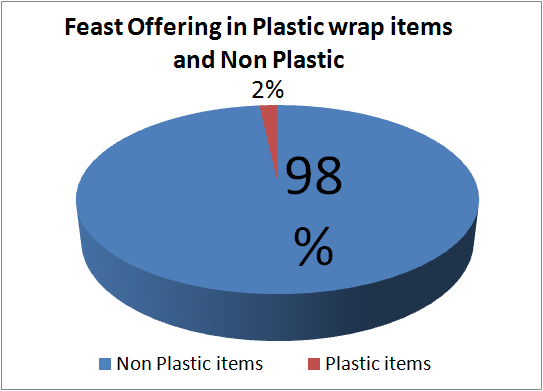
Further, these three food categories are divided into two groups, Non-Plastic Items, and Plastic Items. The homemade foods and fruits, in general, are non-plastic itemsandthe plastic packaged items are categorized under Plastic Items. Therefore, 98% of the feast offerings did not produce plastics while 2% offering has some plastics. The 2% plastic came from bread offering.
The team also looked into how many numbers of plastic plates and cups are reduced in 5 days of Phagma Nyingtik Drubchen. This is done considering the average counting of devotees (248) present during the feast offering session, the number of banana leaves (247) distributed and also the number of cups (231) distributed to the devotees. Further, the average of all these three average countings was considered as a final average figure (that is 242), that represents the number of plastics plates and cups reduced in a day. Therefore, we have concluded that the number of plastic plates reduced in one day of feast offering is 242. Similarly, the number of plastic cups reduced is also 242. The total plastic plates and plastic cups reduced in five consecutive days of Phagma Nyingtik Drubchen are 1,210 plastic plates and 1,210 plastic cups. So, we have found that the total plastic reduced in 5 days of Drubchen is 2,420 plastics.
The team also found that the CGI administration has spent 54% of its total budget on feast offering in this particular Drubchen and this entire amount is invested in 100% plastic free feasts offering. The feast included Rice 20%, vegetables 21%, Fruits 17%, and India Sweets 42%.
The eco-friendly feast offering is H.E. Dzongsar Khyentse Rinpoche’s vision initiated several years ago at Chokyi Gyatso Institute, Dewathang and today this sustainable practice of beautiful feast offering continues to be a living example of Rinpoche’s vision.
Mask project is a part of LME curriculum unit to help students to ignite individual creativity, art skills, and social skills. Hence this short video clip is a project of projects in its aims to offer holistic education for students.
Your Mask is not your boss; you
are your mask's boss!
In fact, we wear many layers of masks.
Do you wear one or many?
Let us put it this way: Have you blamed someone for your fault?
Have you felt slightly uneasy to expose your true imperfect self?
If so, these are symptoms that you are wearing masks! YOU MUST KNOW THAT
our mask is a sign of our weakness. Mask paralyze us from being authentic us.
It shadows us from admitting our perfectly imperfect us. So, know that our mask
is not us.
Therefore, at the least let us consistently Remember that we manifest our masks
on daily basis, if not unmask our masks immediately! Do you want to be a mask-less? It is your choice!
Because
Your mask is not your boss; You are your mask's boss!
Mask making process is creative adventures for students. It provides them to undertake a rigorous process of thoughts to craft their architecture in their own imaginative shape, size, design, colour and their interpretations. The mask making was one of the exciting projects that LME students have carried out as a part of Buddhist Art and Culture unit. The aim of the project was to augment their creative imaginations, give them hands-on experiences, and enhance social interactions. More importantly, the project was to emphasize the importance of process-oriented learning and encourage themto take responsibility in their quest for learning. It was also to make them realize the magic of interdependent reality about how simple process can unfold into their desired product.
The tactile process to select primary materials out of clay, flour, soils, and other possible materials need careful diligence and decision. To carefully pick one, students need to weigh the pros and cons, analyze the best material and take the right decision to choose the right one. It is a lot of thought process for young students. If a student is doing for the first time, the process is research in itself and full of enrichment.
Moulding clay with hands, fingers, and palms can offer a powerful hands-on experience for students to feel through their senses, nonverbal experiences of working physically with the clay. The whole process is about questioning oneself and discovering a satisfactory solution to come up with one’s own creative shape by the end of their project.
Once all the materials are ready students need to think about how to design their masks, to put on creative shape, to make eyes, nose and mouth designs. This painstaking process needs artistic eyes for students to shape, reshape and refine their creation to the best of their motor skills, mathematic sense, visual and other senses.
The mask making process is a craft that requires drying in the sun. As a result, it makes students wait. It is a great way for students to show self-control and patience. It also helps them develop flexibility as they show patience.
Writing reflection about the mask is another activity integrated into the project to give students the opportunity to say and think about their projects. Students were asked to write about their procedure for making their masks; what did their masks represent and what they learned in the process of the project.
As part of Personal and Professional
Development, a group consisting of 5 members—2 from Samdrup Jongkhar Initiative
and 3 from Lho Mon Education took part in a two-week summer retreat (Dathun) from
15th to 28th, August 2018 at Deer Park
Institute, Bir, Himachal Pradesh. This program was
led by a team of Buddhist instructors under Dzongsar Khyentse Rinpoche and Chogyam Trungpa Rinpoche.
The Dathun provided the unique
opportunity to practice sitting meditation including morning and evening chants,
walking meditation, silent meals, silent periods, functional talking, meetings
with senior meditation instructors, and dharma talks. It was a special
opportunity to explore and understand our own minds and the world around us
without pressure or distraction. As intended, the Dathun provided
that space of simplicity and clarity, which is
rarely manageable in our day-to-day work place and mundane lives.
This indeed was our main purpose of this Dathun participation
to have that personal space. For much of the day the participants were
together in complete silence. There was also unscheduled open times for us to
read, take walks or just sit and relax. There were also some household chores
or kitchen work at regular intervals as a part of practice.
The program was designed to follow the
traditional program guidelines: that there be no music, no drinking of
alcohol or taking non-prescription drugs, that reading materials are dharma
books only, and that we take part fully in the schedule.
Although we were not able to continue the
month-long Dathun because of time constraint, the first two
weeks of participation gave us the taste of what it is like to watch our mind
and body with total focus and discipline.
To celebrate the
58th Birth Anniversary of H.E.DzongsarJamyangKhyentseRinpoche, students and teachers of Lhomon Education at ChokyiGyatso Institute
organized few activities such as planting fruit saplings, reciting long
life prayer for Rinpoche, practicing meditation, reciting sutra in English translated by 84000 project, offering
butter lamps, and offeringprostration. It is a humble
tribute that equals to a firefly amongst the sun, the moon, the stars, and
metropolitan lights to cherish and to celebrateRinpoche.
The celebration is a
time for students and teachers alike to reflect on howwecelebrateRinpoche’s
profound vision and aspiration in small ways, yet in holistic manner.So, we had a good discussion about howwe generally celebrate birth day, normally with
cutting cake, blowing off a candle, and bursting of balloons, etc. we questioned on how this
practice helps environment, oneself and others in deeper level. After weighing
all the pros and cons weconcluded
that we need to celebrate the
birthday in holistic manner.We did some brainstorm on holistic
celebration and came up with this list: tree planting, butter lamp offering, saying prayer,
practicing meditation, reading sutra, offering prostration, offering flower,
cleaning environment, cutting cake, dancing, also bursting balloons, etc.
Our approach is to celebrate the day by
contributing few trees to the mother Earth; reading the words of the Buddha; being
generous to self by contemplating; and saying long life prayer for Rinpoche.
This short video is a
tribute to honour Rinpoche! We dedicate our merit to all sentient beings.
The lyric of the song goes ‘‘…Any thought in my mind, reminds me
of dharma practice…’’and it ends ‘‘…I have equity in human birth, but not in
fortune and merit, as I have to leave my own birthplace and linger in others places...’’
This song is a melodious in
tune and good in its message, that reflects the singer’s urge of wanting to
visit the sacred place of dharma and the land of
Guru PadmaJungney, to practice the
Dharma. However, she/he is being in the Samsara has the
responsibility to take care of her/his son and old parents and that makesher/his wish of Dharma practice impossible. As the song melodiously ends, she/he complains, that it is unfortunate and less in merit of her/him
not being able to use the fortunate human birth for Dharma practice.
As we have shared in our last post, the singing of song and playing musicare fun part of study and it is considered as an offering. We hope to use music as a medium to educate our
students and other people through composition and music videos. The profound
concepts such as interdependence, inclusiveness,
karma, kindness, etc. can be taught through the music.
Music is a social art. It enhances team
work, cooperation, and brings people together. Today’s social
media are filled with music and videos. Many young people love singing and listening to music. It is a trend! Why we educators don't take advantage of it?
With this we would like to take this opportunity to thank Mr. Simon
Thomas for your time and effort in raising funds to buy some instruments for LME students. We also
sincerely thank the individual donor for your generous contribution.
Let us not forget the team Misty Terrace. This music video is outcome of inspiration from the team (Tshering Chenmo music video). Thank you Mr. Tandin Wangchuk (Misty Terrace) and your wonderful team mates.

 One such opportunity is to take a field study tour. The tour has to offer wide ranges of experiences that are often memorable, fun and remain intact in one's memory. LME students and teachers took a field visit to Palri Buddha Park, Mukazor, Wamrong to learn about the Twelve Great Deeds of the Buddha. The trip is to facilitate learning through various experiences such as travel, explore, listen, participate, observe and interact. It is also to help develop the values, knowledge, competencies, and practical life skills that will enable them to live full and satisfying lives and to become contributing members of society.